Sunday, 14 November 2010

The secret of life

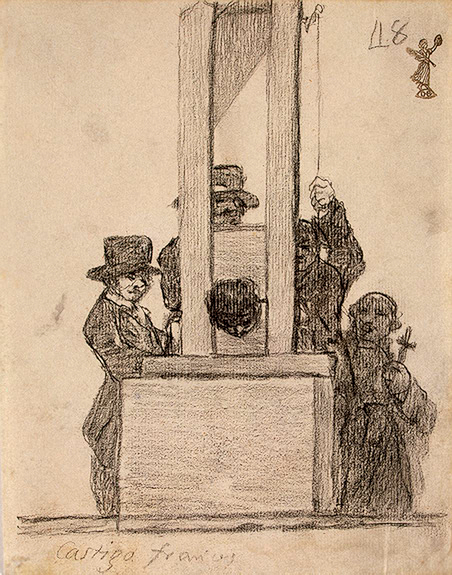
Goya, "The French Penalty", c. 1824
One of the important themes in Pope Benedict's social encyclical is the so-called "right to life", which has become a bone of contention in modern society. "When a society moves towards the denial or suppression of life, it ends up no longer finding the necessary motivation and energy to strive for man's true good" (28). The reason is simple. Man is not "merely the fruit of either chance or necessity" (as the Pope puts it in the section of the right to religious freedom, 29). He is made in God's image, and his life belongs to God. We must not treat it as something over which we have dominion, either to manufacture or destroy, as he discusses in Chapter 6 on technology. Both abortion and euthanasia are fostered by a "materialistic and mechanistic understanding of human life" (75).

Yet the pressures towards both cannot be overestimated. As we have seen with recent changes in sexual ethics, without a firm understanding of why these things are wrong, they soon become socially acceptable and then commonplace. Chesterton once joked that one might overcome the need for birth control by letting all the babies be born and then killing those one didn't like. He was attempting a reductio ad absurdum, but today influential philosophers are advocating infanticide in all seriousness.

So, what is intrinsically wrong with abortion and the "mercy killing" of human beings? We cannot understand this without some appreciation of the notion

Tuesday, 12 October 2010

What's Wrong with the World?

A hundred years ago, in 1910, G.K. Chesterton published a book with this title – probably one of his most important, certainly on Distributism. It contained a critique of modernity, with a focus on imperialism, feminism, education and economics. 

It is, in fact, quite tempting and easy to discourse on what is wrong with the world. Let me have a go right now. (I apologise in advance for spoiling anyone's day.)

Around the globe our democratic political systems are either corrupt, or if not corrupt then blinkered by short-termism, since many of our politicians are only interested in the next term of office, and so can’t deal with profound long-term or systemic problems. The alternatives to democracy, however, are far worse.

Our economic system is inherently unstable, being based on an ideal of

Friday, 8 October 2010

Gratuity in the Market

In Caritas in Veritate, Pope Benedict tells us that “if the market is governed solely by the principle of the equivalence in value of exchanged goods, it cannot produce the social cohesion that it requires in order to function well. Without internal forms of solidarity and mutual trust, the market cannot completely fulfil its proper economic function” (35). That trust has today been severely undermined. He adds that “in commercial relationships the principle of gratuitousness and the logic of gift as an expression of fraternity can and must find their place within normal economic activity” (36). So what do we make of the market, and of the Pope's warning?

There is a kind of flow, or exchange, making the world go round. This is the flow of self-gift, sometimes called love. It is what creates the world, and keeps it going. But it is reflected or echoed within creation in many different ways, and as far as human organization is concerned it is reflected in two main ways. There are two ways in which to exchange or share tangible goods: it may be done either as a gift, or as a transaction. In a transaction – corresponding to contract-style relationships in law involving commodities – one thing is given in return for another. This may be a kind of barter, where I give you my sheep in return for your goats, or it may involve money. Money was invented for situations where I don’t happen to want your goats, or anything else that you have at the moment, but I might want something later. We establish currency as a medium of exchange. Money is therefore a symbol of the spirit of love within the market: it connects everything together and enables it to flow. That explains why it can so easily become a false god.
Wednesday, 29 September 2010

Rights-in-relation: need for an anthropology

Cardinal Angelo Scola, speaking in Venice recently, discussed the phenomenon of the expansion of the notion of 'rights' in the context of modern political discourse without any agreed philosophy underpinning them.
We are faced with a paradox: a hitherto unprecedented circulation and expansion of rights in tandem with a degree of vagueness about their content... Looked at from one side, any catalogue of rights has formidable economic and social implications, but in truth it is itself the product of a certain view of man which is always I-in-relation. To recover the true face of rights it is indispensable to engage with their anthropological and social dimensions: an objective on which the various sciences and disciplines converge, each with its own specificity but in a perspective which increasingly requires a transdisciplinary dimension.
It seems to me that the Cardinal is getting at the following. Human rights can only be based on (a) the inherent or intrinsic value of the person, existing in relation to God, cosmos, environment, and fellow human beings, and (b) the actual needs (rather than wants) of that person in that situation if he is not just to survive but to flourish. This requires that we know at least roughly what a human being is and what causes him to flourish - in other words, we need an adequate anthropology. Without that, we are whistling in the dark.

Tuesday, 7 September 2010

Good relations

Pope Benedict writes in Caritas in Veritate that "a new trajectory of thinking is needed in order to arrive at a better understanding of the implications of our being one family;" adding that "interaction among the peoples of the world calls us to embark upon this new trajectory, so that integration can signify solidarity rather than marginalization." This is the task we have set ourselves for our meeting in Oxford (see last post). The Pope continues:
Thinking of this kind requires a deeper critical evaluation of the category of relation. This is a task that cannot be undertaken by the social sciences alone, insofar as the contribution of disciplines such as metaphysics and theology is needed if man's transcendent dignity is to be properly understood. As a spiritual being, the human creature is defined through interpersonal relations. The more authentically he or she lives these relations, the more his or her own personal identity matures. It is not by isolation that man establishes his worth, but by placing himself in relation with others and with God. Hence these relations take on fundamental importance (53).
This is the foundation of solidarity - the fact that we are relational creatures, not isolated units. Here we immediately run into a difficulty. Belief in God is not universal among us, and it may be a stumbling block for the secular environmentalists. Yet we can surely agree that we are "relations", even if not all of us locate the source of that relationality in God, in the Trinity of relations we call "Persons". Through biology and physics, I am related to and entangled with everything else on earth, especially the things that live and breathe. But more than that, my own sense of identity is bound up with these natural relations. They are not simply traces of my historical descent or effects of my actions. I have to live these relations (as the Pope says) in order to reach a mature identity.

What does that mean? Surely that in order to be true to myself, I must be receptive to the truth, goodness and beauty that reveals itself to me through these relationships. They impose upon me a responsibility, which I cannot shirk without diminishing my own humanity.

Picture: Port Meadow by Rose-Marie Caldecott