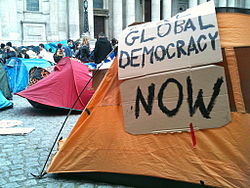
With a mood of fear pervading the markets, the likelihood of another round of economic collapse, the traumas afflicting the eurozone, the resignation of governments, and a spreading protest movement seemingly directed against capitalism itself – not to mention the "Arab Awakening" in the Middle East, the weakness of American leadership, and a possible increase in climate instability – it seems we are living in another interesting time for Catholic social teaching. It may be that even secular economic institutions are prepared to listen. But what are we to say, without falling into the obvious traps? The principles of Catholic teaching are clear enough; the applications less so. This blog will continue to highlight interesting developments, but my main interest is to delve into something more fundamental, namely the fact that economic and political instability have a spiritual dimension. Our mistake is to think of these structures as mechanistic, neutral, implacable, entirely "secular". This way of thinking is part of the divorce between nature and the supernatural in our civilization. Our economic and political woes are all part of the spiritual struggle of our times.
Picture by Neil Cummins licensed through Wikimedia Commons.
Sunday, 13 November 2011
Thursday, 3 November 2011
A global Authority?
The document issued by the Pontifical Council for Justice and Peace (PCJP) under Cardinal Turkson on the global economy and the reform of monetary and financial systems in October 2011 generated a storm of controversy, and has since been roundly repudiated by the Vatican Secretary of State and pulled to pieces in L'Osservatore Romano. Presented as merely a “reflection” and not an authoritative statement binding on the conscience of Catholics, it may still be helpful to look and see what was asserted here.
Monday, 10 October 2011
Special Issue on Ecology
The latest issue of our journal Second Spring, number 14, entitled 'In the Garden", is themed around Nature, Gardens, and Ecology. For us, this is a landmark issue. Not only does it mark a developing focus in our work on issues of development, sustainability, and man's relationship to nature, but this year is the tenth anniversary of the first appearance of Second Spring as an independent journal in 2001.
The Garden issue of Second Spring contains lead articles by Cardinal Angelo Scola (the new Archbishop of Milan, formerly Venice), Mary Taylor (Pax in Terra), and Christopher Blum (Thomas More College). There are also articles on gardening by Vigen Guroian, Jane Mossendew and others. Peter Milward SJ contributes a piece from Japan. Mark Elvins OFM Cap. writes from a Franciscan perspective, and Aidan Hart from the Orthodox Church on the way Icons "transfigure matter". Together with poetry, book reviews, reports, and lots of beautiful illustrations, this is in many ways our best issue yet.
(Several articles on the same theme can be found online in our main articles section at www.secondspring.co.uk, including Keith Lemna on Human Ecology, Environmental Ecology, and Ressourcement Theology. There is also a longer version of the important Second Spring article "Healing the Rift" by Mary Taylor available online. And readers might be interested to read a fascinating study of the universal symbolism of gardens by Mihnea Capruta, from Eye of the Heart issue 4. Some beautiful pictures of Japanese gardens and a discussion of that aesthetic may be found at David Clayton's Way of Beauty site.)
Our issue is quite timely, given the high-profile speech the Pope recently gave to the Bundestag in Berlin, where he emphasized the intrinsic relationship between respect for human life and respect for nature. Pope Benedict said that "the emergence of the ecological movement in German politics since the 1970s... was and continues to be a cry for fresh air which must not be ignored or pushed aside, just because too much of it is seen to be irrational. Young people had come to realize that something is wrong in our relationship with nature, that matter is not just raw material for us to shape at will, but that the earth has a dignity of its own and that we must follow its directives." "If something is wrong in our relationship with reality," he added, "then we must all reflect seriously on the whole situation and we are all prompted to question the very foundations of our culture." He went on:
The Garden issue of Second Spring contains lead articles by Cardinal Angelo Scola (the new Archbishop of Milan, formerly Venice), Mary Taylor (Pax in Terra), and Christopher Blum (Thomas More College). There are also articles on gardening by Vigen Guroian, Jane Mossendew and others. Peter Milward SJ contributes a piece from Japan. Mark Elvins OFM Cap. writes from a Franciscan perspective, and Aidan Hart from the Orthodox Church on the way Icons "transfigure matter". Together with poetry, book reviews, reports, and lots of beautiful illustrations, this is in many ways our best issue yet.
(Several articles on the same theme can be found online in our main articles section at www.secondspring.co.uk, including Keith Lemna on Human Ecology, Environmental Ecology, and Ressourcement Theology. There is also a longer version of the important Second Spring article "Healing the Rift" by Mary Taylor available online. And readers might be interested to read a fascinating study of the universal symbolism of gardens by Mihnea Capruta, from Eye of the Heart issue 4. Some beautiful pictures of Japanese gardens and a discussion of that aesthetic may be found at David Clayton's Way of Beauty site.)
Our issue is quite timely, given the high-profile speech the Pope recently gave to the Bundestag in Berlin, where he emphasized the intrinsic relationship between respect for human life and respect for nature. Pope Benedict said that "the emergence of the ecological movement in German politics since the 1970s... was and continues to be a cry for fresh air which must not be ignored or pushed aside, just because too much of it is seen to be irrational. Young people had come to realize that something is wrong in our relationship with nature, that matter is not just raw material for us to shape at will, but that the earth has a dignity of its own and that we must follow its directives." "If something is wrong in our relationship with reality," he added, "then we must all reflect seriously on the whole situation and we are all prompted to question the very foundations of our culture." He went on:
The importance of ecology is no longer disputed. We must listen to the language of nature and we must answer accordingly. Yet I would like to underline a further point that is still largely disregarded, today as in the past: there is also an ecology of man. Man too has a nature that he must respect and that he cannot manipulate at will. Man is not merely self-creating freedom. Man does not create himself. He is intellect and will, but he is also nature, and his will is rightly ordered if he listens to his nature, respects it and accepts himself for who he is, as one who did not create himself. In this way, and in no other, is true human freedom fulfilled.
Labels:
ecology,
gardening,
Second Spring journal
Friday, 7 October 2011
Sustainability in Crisis
A useful report from The Tablet on a conference about climate change in Cambridge.
Saturday, 10 September 2011
Quote of the month
The philosopher Roger Scruton writes at the end of his article on the British Government's planning reforms:
When people refuse to pull down a cathedral for the sake of the coal beneath it, or insist on retaining a Georgian city when it could be rebuilt as a business park, they create obstacles to economic growth. Most forms of love are obstacles to economic growth. Thank God for obstacles to economic growth.
Subscribe to:
Posts (Atom)
