Showing posts with label Islam. Show all posts

Thursday, 17 May 2012

Rights in Islam

In its modern sense, the concept of human rights could be said to be alien to the Islamic tradition. That is because the modern doctrine of rights is an invention of the European Enlightenment. It was an attempt to base the humane social order on reason rather than revelation. Unfortunately the secular foundations of the doctrine of rights were never successfully secured. Philosophers disagreed on the origin of rights and even on what counts as a right. Some philosophers believed that rights derived from an implicit agreement among human beings to maintain a mutually beneficial social order. Others based rights on some idea of human nature and personal dignity more or less derived from the earlier notion of man as the image of God. But most Enlightenment discourse about rights tended to revolve around the concept of freedom. The most important right was freedom, meaning in this case freedom from constraint (freedom from arbitrary arrest, freedom to speak one's mind, freedom from the authority of the Church, and so on). Even the right to life was defined in terms of freedom – freedom to live one's life without having it taken away.

And yet absence of constraint had been a relatively minor element in the traditional notion of freedom, which we might call the "religious" notion of freedom. Servais Pinckaers OP in his important study The Sources of Christian Ethics has shown that the traditional

Tuesday, 20 March 2012

A Christian country

Is England a Christian country? Secularism takes a different form in England than it does in the USA, even though in both countries the traditional ethos, grounded in natural law, is collapsing, along with the sense of what we are here for (other than making money and having fun). In the US the Church and State are "separated". In England the Church is "established" because its head is also the nominal head of State. This has made it possible for many Christian-derived customs and habits to have been preserved into the twenty-first century. However, the pressure of secularism leads to a watering-down and an emptying-out of Christian conviction. The result is that the commonest form of Christianity in England is not Evangelical or Nonconformist, as it tends to be in the US, but rather a well-meaning but woolly kind of faith that hardly knows what it believes or what it stands for.

It is this semi-secularized Christianity, an instinctive but attenuated adherence to the Christian tradition, that prevails in the United Kingdom. Christianity becomes secularized when it fails to be both intellectually coherent (i.e. rational) and mystical. That is, when it reduces faith to a doctrine or set of beliefs, a bit like pieces of clothing we can choose to wear or not according to taste. Religion without genuine transcendence sits well with the

Monday, 11 July 2011

Liberalism, Consumerism, Islam

In June I attended a conference of the Oasis journal founded by Cardinal Angelo Scola in Venice (recently elected Archbishop of Milan). It is a journal mainly for Christians in Islamic countries, published in English, Arabic, Hindi, and other languages, recommended to anyone who takes an interest in inter-religious questions and the position of Christian minorities in the Middle East and North Africa. The conference this year was about the “Arab Spring”. While listening to the distinguished contributions, my own thoughts moved in the following direction.

In a traditional society, whether Christian or Islamic, human beings live surrounded by reminders of God, which function as a call to prayer. In the world fashioned by modern technology, this is not the case. The environment created by mobile phones, TV, internet, and even modern transport is essentially a new culture, within which religious faith starts to seem irrelevant. (That is, within the world of the imagination, where most people live.)

If the Islamic world is now immersed in this electronic culture, I do not see why the Islamic religion will not go the way of the Christian, and lose much of its dynamic, culture-forming capacity. Recent riots and revolutions seem to have very little to do with Islam, and this may indicate that social behaviour is no longer being shaped primarily by religious conviction, even in its impoverished ideological form (“Islamism”), but rather by material discontent coupled with a sense of solidarity mediated by new technology. This certainly makes it easier to mobilize against tyranny and corruption, which is a great thing, but at the same time it leaves these societies wide open to a consumerism no longer just Western, but fast becoming universal.

Thursday, 24 February 2011

People Power

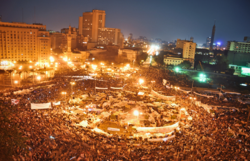
The present wave of revolt across the Middle East -- Tunisia, Egypt, Libya, etc. -- seems to show the power of a rising generation that will no longer stand for rule by dictatorship. The degree to which Islamic belief plays a part in fuelling this revolt is open to question. Nor is it clear what will emerge to replace the regimes and ruling families that are falling. Western newspapers assume the call is for "democracy", but what does that mean, exactly, and what might it mean in a confessional Muslim state? The word itself literally means "people power". But how are the people to exercise their power,

Friday, 11 June 2010

Religion and Ecology

HRH the Prince of Wales was in Oxford this week to give a speech on Islam and the Environment. The whole speech can be viewed or read on his web-site, but here is an extract:
I would like you to consider very seriously today whether a big part of the solution to all of our worldwide “crises” does not lie simply in more and better technology, but in the recovery of the soul to the mainstream of our thinking. Our science and technology cannot do this. Only sacred traditions have the capacity to help this happen.

In general, we live within a culture that does not believe very much in the soul anymore – or if it does, won’t admit to it publicly for fear of being thought old fashioned, out of step with “modern imperatives” or “anti-scientific.” The empirical view of the world, which measures it and tests it, has become the only view to